
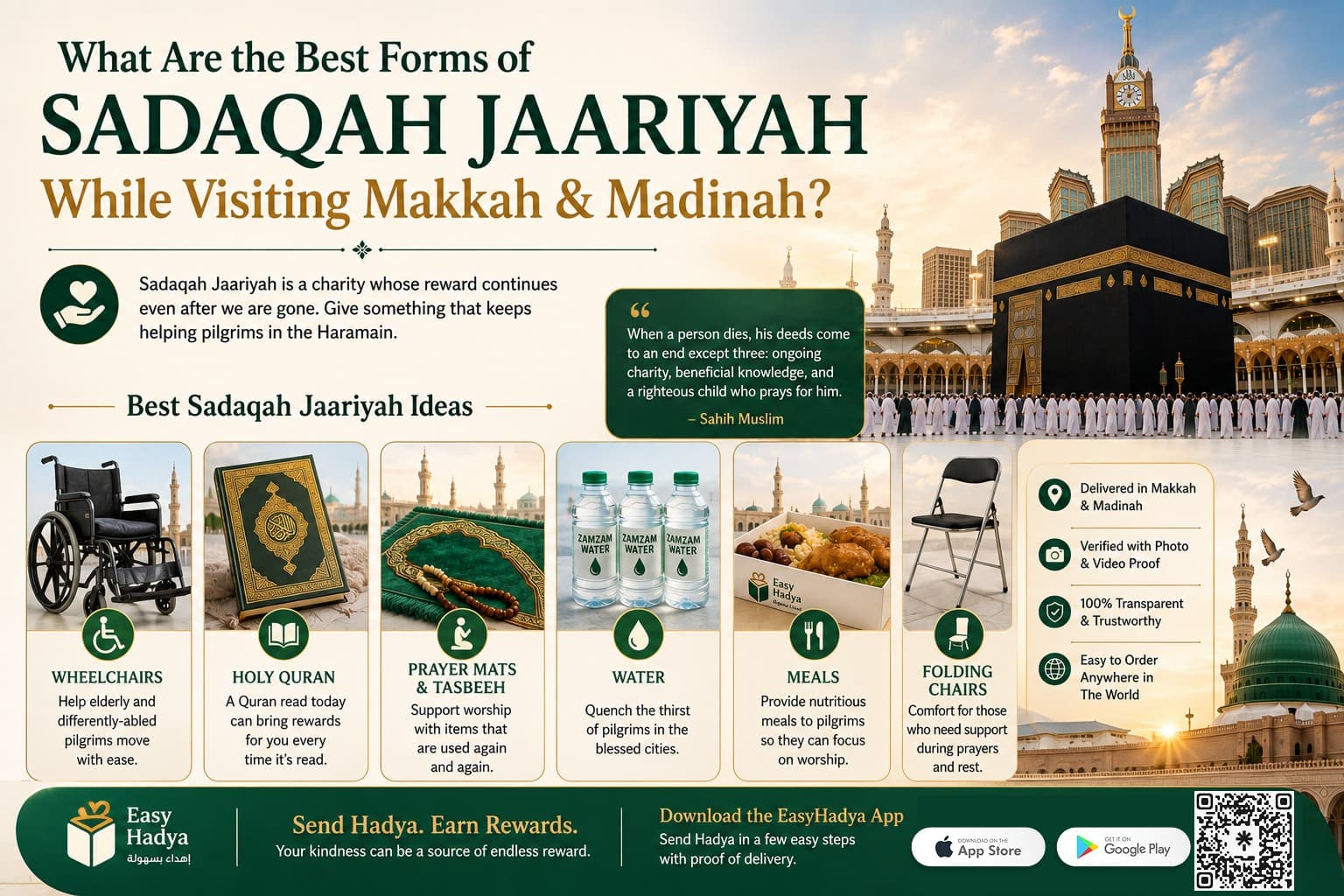
What Are the Best Forms of Sadaqah Jaariyah While Visiting Makkah and Madinah?
Visiting Makkah and Madinah is a deeply meaningful experience. Between performing Umrah, praying in the holy mosques, making dua and reflecting on your relationship with Allah, you may also begin thinking about how your journey can benefit other people.
One common question is:
What is the best sadaqah jaariyah to give while visiting Makkah or Madinah?
Some visitors think about providing water. Others want to give Qurans, prayer mats, wheelchairs or meals to pilgrims. These are all valuable forms of kindness, but they do not automatically fall into the same religious category.
A single meal, for example, is a meaningful sadaqah because it provides immediate benefit. A wheelchair that continues to support different pilgrims may provide a longer-lasting benefit. A Quran that remains available and is read repeatedly may also continue benefiting people over time.
The difference matters because sadaqah jaariyah means a form of charity whose benefit continues.
The Prophet Muhammad ﷺ explained that when a person dies, their deeds end except for three things: ongoing charity, beneficial knowledge and a righteous child who prays for them.
This guide explains the best forms of sadaqah jaariyah you can consider during a visit to Makkah and Madinah. It also discusses practical Hadya options such as wheelchairs, Qurans, prayer mats, water and recurring meals that can be arranged for pilgrims through EasyHadya.
Important note: This article provides general educational information. Questions about whether a particular gift qualifies as sadaqah jaariyah in your specific situation should be referred to a qualified Islamic scholar.
What Does Sadaqah Jaariyah Mean?
Sadaqah is voluntary giving performed for the sake of Allah. It can include money, food, water, useful items, assistance, knowledge or other acts of kindness.
Sadaqah jaariyah is a more specific type of giving.
The word jaariyah carries the meaning of something that continues or flows. Therefore, sadaqah jaariyah normally refers to charity that continues benefiting people after the original gift has been made.
A simple way to understand it is:
- Sadaqah provides benefit.
- Sadaqah jaariyah provides continuing benefit.
For example, giving one bottle of water to a thirsty pilgrim is a valuable sadaqah. Supporting a reliable water system or arranging recurring water distribution may create a continuing benefit.
Giving one meal is an important act of kindness. Arranging meals every Friday or throughout the year creates an ongoing pattern of giving, although scholars may distinguish between a recurring personal donation and a permanent charitable endowment.
Similarly, giving a wheelchair may become a longer-lasting form of benefit when the wheelchair is durable, properly maintained and used by several pilgrims over time.
Allah describes spending in His cause through the example of a grain that grows seven ears, with one hundred grains in each ear, and states that He multiplies the reward for whom He wills.
The focus should therefore be on sincere intention, lawful earnings, genuine usefulness and respectful fulfilment.
What Is the Difference Between Sadaqah and Sadaqah Jaariyah?
This distinction is important when choosing your Hadya in Makkah or Madinah.
Immediate sadaqah
Immediate sadaqah solves a present need.
Examples include:
- Giving a meal to a pilgrim
- Handing water to someone who is thirsty
- Providing dates or juice
- Paying for someone’s transport
- Helping an elderly visitor
- Giving a small personal care package
- Offering an umbrella during hot weather
These actions may create significant benefit and reward, even when the item is consumed only once.
Ongoing sadaqah
Ongoing sadaqah continues serving people.
Examples may include:
- A wheelchair used repeatedly
- A Quran read by many people
- A durable prayer chair
- A water cooler that is refilled and maintained
- A recurring Hadya programme
- Financial support for beneficial Islamic education
- A useful facility that remains available
- A properly managed waqf or endowment
The value of a gift should not be judged only by how long it lasts. A meal given to a hungry person can be extremely important. However, if your specific intention is sadaqah jaariyah, you should select an option with a clear continuing benefit.
Why Give Sadaqah While Visiting Makkah and Madinah?
A visit to Makkah or Madinah often changes how a person thinks about time, wealth and priorities.
You see worshippers from many countries. Some are young and healthy. Others are elderly, unwell, tired or experiencing limited mobility. Many have saved for years to complete their journey.
This environment may encourage you to look beyond your own visit and ask:
- How can I make another pilgrim’s journey easier?
- What useful item can remain after I return home?
- Can I arrange something in the name of my parents?
- Can I create an ongoing Hadya habit?
- How can I give without embarrassing the recipient?
Giving in the holy cities should not become a competition or a public display. A meaningful Hadya can be simple, private and focused entirely on helping another person.
The best form will depend on your budget, intention and the genuine needs of the people being served.
1. Providing a Wheelchair for Pilgrims
A wheelchair is one of the most practical Hadya options for pilgrims with limited mobility.
Performing Tawaf and moving between Safa and Marwah can require considerable physical effort. Travelling between accommodation, transport areas and prayer locations may also be difficult for elderly people and those living with illness, injury or disability.
A wheelchair can help a pilgrim:
- Move with greater comfort
- Reduce physical strain
- Maintain personal dignity
- Reach important locations
- Participate more easily in worship
- Rest when walking becomes difficult
Can a wheelchair be sadaqah jaariyah?
A wheelchair may provide ongoing benefit when it is used repeatedly and remains in good working condition.
However, you should not automatically assume that every wheelchair order is permanent or shared. Some wheelchairs may be given directly to one person. Others may be placed with an authorised organisation or made available to several pilgrims.
Before arranging a wheelchair Hadya, ask:
- Is the wheelchair given to an individual?
- Will it be available for repeated use?
- Who will maintain it?
- Where will it be distributed?
- How will delivery be confirmed?
- Will it remain available after the first use?
The longer and more reliably the wheelchair helps people, the stronger its continuing-benefit character may be.
EasyHadya offers a way to arrange a wheelchair Hadya for pilgrims and describes its service as locally fulfilled with photo and video proof. Its published guidance explains that wheelchair support is intended to reduce physical strain and help elderly or mobility-limited pilgrims.
Who might arrange a wheelchair Hadya?
A wheelchair may be arranged:
- In your own name
- On behalf of your parents
- In memory of someone who has passed away
- As a family Hadya
- By a mosque or community group
- To mark a personal milestone
- As part of a regular mobility-support programme
Because the classification of a specific arrangement can depend on how it is managed, consult a scholar if you intend to label it formally as sadaqah jaariyah.
2. Gifting Copies of the Holy Quran
Providing access to the Quran is one of the best-known examples of a gift connected with continuing benefit.
When a person reads from a Quran, studies it, memorises from it or teaches another person using it, the copy continues to serve a valuable purpose.
A Quran Hadya may be placed in:
- An authorised mosque
- A Quran learning centre
- A school
- A hospital prayer room
- Accommodation used by pilgrims
- A community library
- A recognised Islamic organisation
- The home of someone who needs a copy
Can a Quran be sadaqah jaariyah?
A Quran can provide ongoing benefit for as long as it remains usable and people continue reading from it.
Its usefulness may increase when you choose:
- Clear and accurate printing
- A suitable font size
- A durable binding
- A trusted Arabic edition
- An appropriate translation
- Large-print copies for elderly readers
- Braille or accessible formats, where available
- Copies needed by students or new Muslims
The aim should not simply be to distribute the greatest number of copies. A smaller number of well-placed Qurans that people genuinely use may create more meaningful benefit.
Can you personally leave a Quran inside Masjid al-Haram or Masjid an-Nabawi?
You should not assume that any personally purchased copy can simply be placed on a shelf inside the Two Holy Mosques.
The management of Quran copies in the holy mosques is handled through official departments and designated distribution arrangements. Saudi authorities distribute approved copies and have established managed sites for Quran distribution.
Therefore:
- Do not leave an unapproved Quran without permission.
- Ask an official representative or authorised service.
- Confirm the required edition and size.
- Use a recognised Quran-waqf or distribution channel.
- Avoid creating extra work for mosque staff.
- Request clear information about where the copy will be placed.
A Quran Hadya does not have to be placed inside Masjid al-Haram or Masjid an-Nabawi to be valuable. It may provide substantial benefit in a smaller mosque, learning centre, hotel prayer room or community where copies are genuinely needed.
3. Providing Durable Prayer Mats
Prayer mats are practical gifts for worshippers and travellers.
A pilgrim may use a prayer mat in accommodation, a rest area or another clean location. A durable prayer mat may continue serving the same person for months or years.
Prayer mats can be especially useful for:
- Travellers who did not bring one
- Elderly worshippers
- People staying in shared accommodation
- New Muslims
- Quran students
- Smaller prayer spaces
- Visitors continuing their journey after Umrah
Is a prayer mat sadaqah jaariyah?
It may provide continuing benefit while it remains in use, but not every prayer mat should automatically be marketed as guaranteed sadaqah jaariyah.
The duration and nature of the benefit matter.
Choose mats that are:
- Comfortable but easy to carry
- Made from durable material
- Easy to clean
- Suitable for frequent use
- Not excessively heavy
- Distributed through a responsible channel
EasyHadya’s Gift of Kindness range includes prayer-related items intended to support pilgrims in Makkah and Madinah. Its published product content describes prayer mats as lightweight items that support worship and are easy to carry.
For a stronger ongoing effect, consider giving a set of mats to a smaller mosque, learning centre or managed prayer area where they can be used repeatedly.
4. Providing Folding Prayer Chairs
Some worshippers cannot stand for long periods or sit comfortably on the floor.
A folding prayer chair may support:
- Elderly pilgrims
- People recovering from surgery
- Worshippers with joint conditions
- People with back or knee pain
- Visitors experiencing temporary weakness
- People living with disabilities
A durable chair can remain useful long after the original delivery. If it is placed in a managed prayer space and used by different people, it may provide a continuing form of benefit.
Before arranging prayer chairs, confirm:
- Whether the location accepts them
- Where they will be stored
- Whether they will be available for repeated use
- Who will check their condition
- Whether the chair is safe and stable
- Whether official permission is required
Avoid leaving chairs, mats or other equipment inside a mosque without permission. Even a well-intended gift can become an obstruction if it is placed in an unauthorised area.
5. Providing Water for Pilgrims
Water is among the most direct and useful forms of sadaqah.
A narration in Sunan Abi Dawud reports that when the Prophet ﷺ was asked which sadaqah he liked most, he replied, “Water.” The narration is graded Hasan on the cited source.
Pilgrims may need water after walking, travelling, waiting for transport or spending time outside. Providing sealed drinking water can offer immediate relief.
Is bottled water sadaqah jaariyah?
One bottle of water is normally a consumable gift. Once it has been used, the physical benefit of that bottle ends.
It is still valuable sadaqah, but it should not automatically be described as permanent ongoing charity.
Water giving can have a more continuing structure when you:
- Arrange recurring water distribution
- Provide water every Friday
- Sponsor water throughout Ramadan
- Fund a maintained drinking-water facility
- Support a refillable cooler
- Contribute to an approved water system
- Create a monthly water Hadya
- Arrange water in the name of a loved one throughout the year
The ongoing element comes from the continuing supply or lasting facility, not merely from calling a one-time bottle “sadaqah jaariyah.”
EasyHadya includes water among the useful Hadya options that can be arranged for pilgrims in Makkah and Madinah. Its published guide also advises users to check bottle quantity, size and distribution location before ordering.
6. Arranging Recurring Meals for Pilgrims
A meal is one of the most immediate ways to care for someone.
After travel, walking and long periods of worship, a fresh meal can provide comfort and energy. Meals may also be shared with drivers, workers, visitors and other people serving or travelling within the holy cities.
Are meals sadaqah jaariyah?
A single meal is generally a one-time benefit. That does not reduce its value as sadaqah.
If you want to create an ongoing pattern, you could arrange:
- Weekly Friday meals
- Monthly meal distribution
- Meals throughout Ramadan
- A family-funded annual programme
- Recurring Hadya during Umrah seasons
- Meals on behalf of a loved one
- A fixed number of meals every month
This creates continuity in your giving, even if each individual meal is consumed once.
EasyHadya states that its local team sources fresh halal ingredients and delivers Hadya meals in Makkah and Madinah with verified photo and video proof. The platform serves individuals, families, organisations and businesses.
When arranging meals, check:
- The type of food
- Portion size
- Packaging
- Number of meals
- Preparation time
- Distribution city
- Delivery schedule
- Food-safety standards
- Proof policy
A meal should be fresh, respectful and suitable for the people receiving it.
7. Supporting Beneficial Knowledge
The hadith about ongoing reward mentions beneficial knowledge alongside recurring charity.
You may support beneficial knowledge by:
- Providing Qurans to students
- Funding Quran-learning materials
- Supporting Islamic classes
- Providing accessible translations
- Sponsoring books for a learning centre
- Supporting digital educational resources
- Helping a student obtain useful study materials
- Providing large-print Qurans for elderly readers
This can be particularly meaningful in Madinah, where many visitors are interested in learning more about the Quran, Islamic history and the life of the Prophet ﷺ.
However, ensure that the material is:
- Accurate
- Produced by a trusted source
- Suitable for its intended audience
- Distributed with permission
- Written in a language recipients understand
- Placed where it will actually be used
Giving books that remain unopened is less effective than carefully selecting material for people who need it.
8. Providing Umbrellas and Reusable Pilgrim Equipment
An umbrella can offer shade and make outdoor travel more comfortable.
A strong umbrella may be used repeatedly by a pilgrim during Hajj or Umrah and may continue being used after the journey.
Other reusable items might include:
- Walking supports
- Reusable water containers
- Small travel bags
- Durable footwear bags
- Portable prayer items
- Weather-protection equipment
These gifts can be useful, although they may not have the same lasting character as a managed wheelchair, Quran waqf or permanent water facility.
Focus on practical value rather than forcing every useful item into the sadaqah-jaariyah category.
EasyHadya lists umbrellas, prayer mats, tasbeehs, Qurans, wheelchairs, folding chairs, meals and water among the Hadya options discussed for pilgrims.
9. Creating an Ongoing Hadya Plan
One of the simplest ways to make your giving continue is to create a recurring Hadya routine.
Instead of giving only during your trip, you can decide that your visit to Makkah or Madinah will become the beginning of a long-term habit.
For example:
- Water on the first Friday of every month
- A wheelchair at a fixed interval
- Qurans several times each year
- Meals during Ramadan
- Prayer mats before the Hajj season
- An annual Hadya in your parents’ names
- A family-funded package every month
- A combination of food and durable items
This approach connects your journey with consistent action after you return home.
EasyHadya has an Ongoing Hadya section and positions its platform as a way for Muslims worldwide to arrange locally fulfilled Hadya in Makkah and Madinah. The website also promotes online ordering through its iOS and Android applications.
A recurring payment by itself does not automatically prove that a programme is a formal waqf. However, it can help you maintain a regular habit of giving and continue supporting pilgrims.
Which Form of Sadaqah Jaariyah Is Best?
There is no single answer that applies to everyone.
The best option may depend on:
- The sincerity of your intention
- The item’s real usefulness
- How long the benefit will continue
- Whether it is properly managed
- Whether recipients genuinely need it
- Your available budget
- The reliability of the fulfilment organisation
- Whether the gift respects local rules
- Whether it preserves the recipient’s dignity
A modest but well-managed gift may be better than an expensive item that is poorly placed, unnecessary or never used.
Consider these practical combinations:
Small budget
- A durable prayer mat
- A Quran through an approved channel
- Recurring bottled-water distribution
- A contribution towards a shared wheelchair
Medium budget
- Several Qurans for a learning centre
- Folding prayer chairs
- Monthly meal and water distribution
- A combination of prayer mats and Qurans
Larger budget
- One or more wheelchairs
- A managed mobility-support programme
- A maintained water facility
- Recurring Hadya packages throughout the year
The amount is not the only measure. Quality, need and continuity matter.
How to Give Responsibly in Makkah and Madinah
Giving in busy religious locations requires care.
1. Check local permission
Do not place Qurans, chairs, food boxes or equipment inside the holy mosques without approval.
2. Choose useful items
Ask what is genuinely needed. Avoid giving objects only because they look impressive.
3. Protect people’s dignity
Do not pressure recipients to appear in photos or videos. Proof should document fulfilment without humiliating anyone.
4. Confirm the delivery method
Understand whether the item is given to one person, distributed among several people or placed in a managed location.
5. Review quality
A broken wheelchair, unstable chair or poorly printed Quran does not create the intended benefit.
6. Use authorised services
Check registration details, contact information, local operations and proof procedures.
7. Avoid exaggerated religious promises
No company should guarantee a specific reward from Allah. A service can explain what it delivers, but the acceptance and reward of an act belong to Allah.
How EasyHadya Helps You Arrange Hadya
EasyHadya is a Saudi-registered platform for Hadya fulfilment in Makkah and Madinah. Its website states that the business operates under The Comfort Corner and publishes Saudi Commercial Licence number 7050597082.
Through the platform, users can explore Hadya options such as:
- Wheelchairs
- Qurans
- Prayer mats
- Folding chairs
- Water
- Meals
- Dates
- Tasbeehs
- Umbrellas
- Combination packages
EasyHadya states that its local team manages preparation and distribution and provides photo or video proof for eligible fulfilments.
How the process works
- Choose Makkah or Madinah.
- Select the Hadya you want to arrange.
- Check the item quantity and description.
- Complete the order through the official platform.
- The local team prepares or sources the item.
- The Hadya is distributed in the selected city.
- You receive an order update or proof where included.
Before ordering, confirm whether the selected product is a one-time Hadya, a durable item or part of an ongoing plan.
Can You Give Sadaqah Jaariyah on Behalf of Someone Else?
Many Muslims give sadaqah on behalf of parents, relatives or people who have passed away.
You may choose to arrange:
- A wheelchair in a parent’s name
- Qurans in memory of a loved one
- Recurring water distribution
- Regular meals
- Prayer equipment for ongoing use
- A family Hadya shared by several people
Your intention can be made privately. A name does not always need to be printed on the item.
For a ruling relating to a specific person, deceased relative, vow or financial arrangement, consult a qualified Islamic scholar.
Download the EasyHadya App
Continue your Hadya beyond your journey by using the EasyHadya app on iOS or Android. Explore wheelchairs, Qurans, prayer mats, water, meals and other useful gifts for pilgrims in Makkah and Madinah. Select your preferred city, complete your order online and receive photo or video proof for eligible fulfilments. The app provides a practical way to arrange Hadya from home, during your visit or after you have returned.
Frequently Asked Questions
What is the best sadaqah jaariyah in Makkah?
Durable, responsibly managed gifts are strong options. These may include reusable wheelchairs, approved Quran copies, maintained prayer chairs and continuing water arrangements.
What is the best sadaqah jaariyah in Madinah?
Qurans distributed through approved channels, mobility aids, prayer equipment and recurring support for visitors may provide continuing benefit in Madinah.
Is giving a Quran sadaqah jaariyah?
A Quran may provide ongoing benefit while people continue reading, studying or teaching from it. It should be an accurate copy placed through an approved and useful channel.
Can I leave a Quran inside Masjid al-Haram?
Do not assume that a personally purchased Quran may be left inside. The holy mosque’s Quran copies and distribution are officially managed, so use an authorised channel or ask the responsible authority first.
Can I place a Quran in Masjid an-Nabawi?
Use an official or authorised process. Do not leave books on shelves without confirming permission and the required edition.
Is giving a wheelchair sadaqah jaariyah?
It may provide continuing benefit if it remains usable and supports pilgrims repeatedly. The exact ruling depends on how the wheelchair is distributed, owned and maintained.
Is bottled water sadaqah jaariyah?
A single bottle is normally a one-time sadaqah. A maintained water facility or recurring water programme has a clearer continuing element.
Are meals considered sadaqah jaariyah?
A single meal is generally immediate sadaqah. Regular meal distribution creates an ongoing habit, although it is not necessarily the same as a permanent waqf.
Can I arrange sadaqah jaariyah after returning home?
Yes. A local fulfilment service can arrange Hadya in Makkah or Madinah while you are in another country.
Can I give sadaqah jaariyah for my parents?
You may give charity with the intention of benefiting your parents. Consult a qualified scholar if you need advice about a specific religious or financial situation.
Should I ask recipients to appear in the delivery video?
No. Recipient dignity and privacy should come first. Proof can show the prepared items and respectful fulfilment without forcing people to appear on camera.
How do I know that my Hadya was delivered?
Choose a registered service with clear product descriptions, local operations, support information and a documented proof process.
Final Thoughts
The best sadaqah jaariyah in Makkah and Madinah is not necessarily the largest or most expensive gift.
It is the gift that is sincere, lawful, useful and managed in a way that allows the benefit to continue.
A wheelchair may help elderly pilgrims move more comfortably. A Quran may support years of reading and learning. A prayer chair may assist many worshippers. A continuing water or meal programme can turn one moment of generosity into a lasting habit.
At the same time, do not overlook ordinary sadaqah. A bottle of water, fresh meal or simple umbrella may meet an immediate need at exactly the right moment.
Choose your Hadya thoughtfully. Confirm how it will be used. Respect the rules of the holy places. Protect the dignity of the people receiving it.
Through EasyHadya, you can explore practical Hadya options for pilgrims in Makkah and Madinah, arrange local fulfilment and receive proof for eligible deliveries. Your journey may last only a few days, but the kindness it inspires can continue long after you return home.