
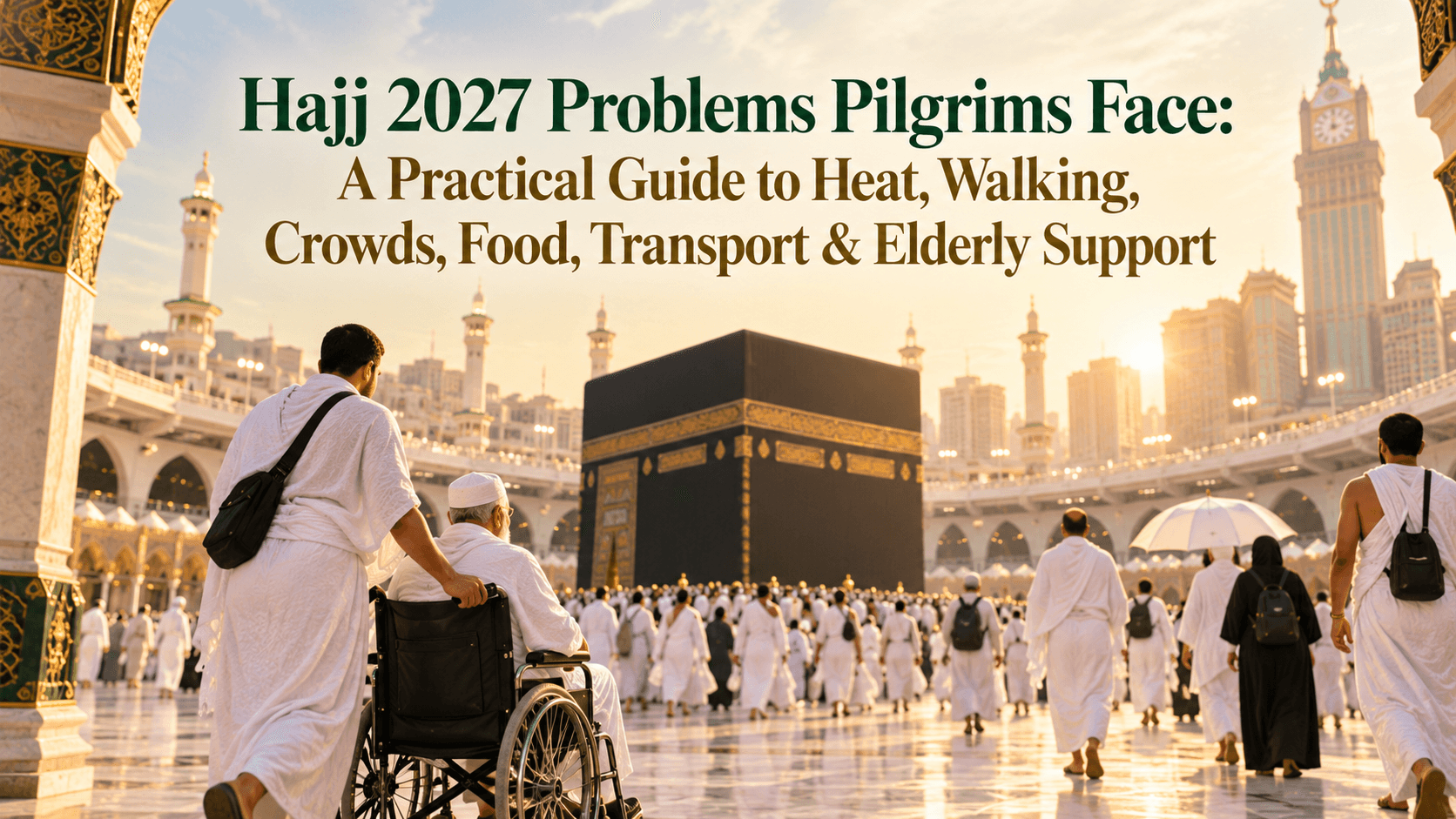
Hajj 2027 Problems Pilgrims Face: A Practical Guide to Heat, Walking, Crowds, Food, Transport & Elderly Support
Hajj Is a Spiritual Journey — But Good Preparation Solves Many Practical Problems
A pilgrim may spend years waiting for Hajj.
They save money. Complete registration. Arrange documents. Prepare Ihram. Learn the rituals. Then finally, the opportunity arrives.
But many first-time pilgrims discover something only after reaching Saudi Arabia:
Knowing the rituals is only one part of being prepared for Hajj.
Hajj is also physically demanding.
There can be long walks. Intense heat. Large crowds. Transport delays. Changes in routes. Limited rest. Foot pain. Dehydration. Difficulty finding family members. And for people travelling with elderly parents, every one of these challenges can become more serious.
Recent Hajj 2026 community reports described the pilgrimage as spiritually powerful but physically and logistically difficult. Pilgrims repeatedly mentioned transport delays, crowd pressure, sickness, heat, bathrooms, communication problems and unexpected walking distances.
That does not mean pilgrims should fear Hajj.
It means they should prepare for the real journey, not only the ideal itinerary.
This guide looks at the most common practical Hajj problems and how future Hajj 2027 pilgrims can prepare for them.
Problem 1: Underestimating How Much Walking Hajj Requires
This is one of the biggest mistakes first-time pilgrims make.
A hotel may look close.
A bus may be scheduled.
A route may appear simple.
But during Hajj, crowd-management measures, road closures and transport arrangements can change how far you actually walk.
One Hajj 2026 pilgrim reported that route closures sometimes created much longer walks than expected. Another advised several months of walking practice before Hajj because the physical distances quickly become exhausting.
The CDC's Hajj guidance notes that depending on accommodation and transport arrangements, some pilgrims may walk approximately 55–65 km across the five main Hajj days.
Solution: Start Physical Preparation Months Before Hajj
Do not start preparing your body one week before departure.
Build walking gradually.
For example:
Begin with comfortable daily walks.
Increase distance slowly.
Practise walking in the shoes you plan to use.
Learn how your feet respond after several kilometres.
Take stairs when appropriate.
If you have a chronic condition or reduced mobility, discuss a suitable activity plan with your healthcare professional.
The objective is not athletic fitness.
It is developing enough endurance that normal Hajj movement does not become overwhelming.
Problem 2: Heat Exhaustion and Heatstroke
Heat is not a minor inconvenience during Hajj.
It can become a serious health risk.
Saudi Ministry of Health guidance identifies heat exhaustion and dehydration among the most common health problems experienced during Hajj. Pilgrims are advised to drink adequate water, use umbrellas, avoid direct sunlight when possible and rest if they experience fatigue or dizziness.
Official Nusuk health guidance also recommends reducing exposure to high temperatures, seeking shade or ventilated areas and maintaining hydration and electrolyte balance.
Warning Signs Pilgrims Should Know
Possible signs of heat-related illness include:
- Extreme thirst
- Headache
- Heavy sweating
- Weakness
- Dizziness
- Nausea
- Muscle cramps
- Confusion
Saudi health guidance states that someone experiencing heat symptoms should move to a cooler location and begin cooling and hydration measures; if symptoms do not improve promptly or severe symptoms occur, seek medical help.
Solution
Avoid unnecessary outdoor exposure during peak heat when possible.
Use shade.
Carry water.
Take regular breaks.
Use an umbrella where permitted and practical.
Know where medical assistance is available.
Most importantly, do not ignore symptoms simply because you want to complete an activity immediately.
Your safety matters.
Problem 3: Dehydration
Many pilgrims underestimate dehydration because they are focused on completing rituals.
You may not immediately feel thirsty.
You may avoid drinking because toilets are inconvenient.
You may simply forget.
But high temperatures, sweating and physical exertion increase fluid loss.
Official Nusuk guidance lists symptoms including thirst, dry mouth, fatigue, dizziness, reduced urine output, muscle cramps and rapid heartbeat.
Solution: Make Hydration Part of Your Schedule
Do not wait until you become extremely thirsty.
Carry water where practical.
Drink regularly.
Follow individual medical advice if you have conditions where fluid intake needs to be controlled.
Include hydrating foods where appropriate.
Avoid excessive caffeine if it affects your hydration.
Problem 4: Elderly Parents Becoming Exhausted
Hajj with elderly parents requires a completely different mindset.
A younger pilgrim may be able to walk for hours.
A parent may be able to walk for twenty minutes before needing rest.
A Hajj 2026 pilgrim who travelled with older parents described significant stress around their health and advised older people or those uncertain about their fitness to prioritise health and dependable support.
Official Nusuk guidance also specifically acknowledges that falls are more likely among elderly pilgrims because of crowding and physical demands.
Solution: Plan Around the Oldest Person
Do not expect your parent to follow the pace of the youngest family member.
Instead, ask:
How far can they comfortably walk?
Do they require a wheelchair?
Do they need a foldable chair?
How often do they need rest?
Do they take regular medication?
Can they tolerate heat?
Would a shorter route be safer?
A recent pilgrim checklist specifically recommended a lightweight folding stool for parents who cannot walk long distances without resting.
Practical assistance can make a major difference.
Problem 5: Foot Pain, Blisters and Muscle Fatigue
Feet can become one of the biggest problems during Hajj.
Long walking distances plus heat and crowded conditions can result in:
- Blisters
- Swelling
- Muscle fatigue
- Ankle discomfort
- Chafing
Hajj 2026 pilgrims repeatedly recommended comfortable footwear and warned that blisters can turn a manageable Hajj into an unnecessarily difficult one.
Solution
Break in footwear before travelling.
Do not use brand-new shoes for the first time during Hajj.
Carry appropriate blister supplies.
Keep feet dry where possible.
Rest when necessary.
Prepare physically before the journey.
For persistent or severe pain, seek appropriate medical advice rather than simply pushing through.
Problem 6: Transport Delays
Pilgrims sometimes assume that transport will move exactly according to a normal city timetable.
Hajj does not operate like a normal week in Makkah.
Millions of people are moving between:
- Makkah
- Mina
- Arafat
- Muzdalifah
- Jamarat
Recent pilgrims reported long bus waits, full buses, route changes and delays.
Official transport systems use operational manifests and approved boarding arrangements for movements to the holy sites.
Solution: Expect Delays Before They Happen
Keep essential medication with you.
Carry water.
Keep your phone charged.
Use a power bank.
Follow your group's instructions.
Do not separate from your group unnecessarily.
Avoid planning important activities with zero time buffer.
During Hajj, patience is not just spiritual advice.
It is practical logistics.
Problem 7: Getting Lost or Confused by Routes
Masjid al-Haram, Mina and the surrounding pilgrimage areas are large.
Crowd management can also cause entrances or routes to change.
A pilgrim may know where something is physically located but still struggle to reach it because access routes have changed.
One 2026 pilgrim reported walking several extra kilometres simply trying to understand entrances and routes around the Haram.
Solution
Save your:
- Hotel location
- Camp location
- Group leader number
- Transport details
- Emergency contact
- Meeting point
Take screenshots in case mobile connectivity becomes unreliable.
Learn to use offline maps where useful.
If travelling with elderly people, consider placing a simple identification/contact card in their bag or pocket.
Problem 8: Phones Running Out of Battery
Your phone may contain:
- Hotel details
- Group contacts
- Maps
- Nusuk information
- Transport information
- Family communication
- Payment access
A dead battery can therefore become more than a minor inconvenience.
Solution
Carry a reliable power bank.
Charge every night.
Do not unnecessarily run high-power applications.
Keep important addresses and numbers written somewhere physically as backup.
Problem 9: Overpacking
Social media Hajj packing videos can make people think they need dozens of specialised items.
Recent Hajj 2026 pilgrims specifically warned against overpacking, noting that many everyday essentials are readily available locally.
Solution: Pack for Problems You Are Likely to Have
Prioritise:
- Required documents
- Ihram
- Comfortable clothing
- Medication
- Comfortable footwear
- Basic hygiene items
- Power bank
- Small practical bag
- Appropriate sun protection
- Small first-aid essentials
Avoid carrying unnecessary weight.
During Hajj, every extra item eventually becomes something you have to move.
Problem 10: Not Preparing for Crowds
Hajj is one of the world's largest annual human gatherings.
Saudi health authorities emphasise that the scale and density of pilgrims increase both health and crowd-related risks.
Crowds can cause:
- Slow movement
- Separation
- Anxiety
- Increased fatigue
- Longer routes
Solution
Do not push.
Follow official directions.
Avoid moving against crowd flow.
Keep elderly relatives close.
Establish a meeting point before entering highly crowded areas.
Never assume the family will remain together automatically.
Problem 11: Respiratory Illness
Large gatherings also increase exposure to respiratory infections.
Saudi health guidance identifies respiratory infection among common Hajj health issues and recommends hygiene and preventive measures.
Solution
Follow current official health guidance.
Wash hands regularly.
Carry appropriate personal hygiene supplies.
Use masks where advised or appropriate.
Do not share personal items unnecessarily.
Seek medical help if symptoms become concerning.
Problem 12: Travelling With Existing Health Conditions
Hajj can place additional strain on people with:
- Heart conditions
- Diabetes
- Respiratory conditions
- Reduced mobility
- Other chronic illnesses
For Hajj 2027, some national authorities are already incorporating medical fitness assessments into the pilgrimage process. Singapore's 2027 Hajj guidance, for example, notes medical assessments and specific Saudi medical-fitness requirements for prospective pilgrims.
Solution
Consult your doctor before travelling.
Carry medication in appropriate packaging.
Keep prescriptions and medical documentation where required.
Make sure another family member understands your medication routine.
Do not change medicine based on internet advice.
Problem 13: Food Timing During Busy Hajj Days
Food may be provided through the pilgrim's Hajj package, but individual experiences can vary.
Pilgrims may also find themselves away from accommodation for extended periods.
The issue is sometimes not finding food.
It is having food when you actually need it.
Solution
Understand what your Hajj operator provides.
Keep a small appropriate snack when needed.
Maintain regular meals if required for medication or health conditions.
Avoid experimenting excessively with unfamiliar food when your stomach is already under stress.
Problem 14: Not Understanding the Hajj Provider's Responsibilities
Many logistical problems begin before travelling.
Pilgrims sometimes book a package without fully understanding:
- Hotel arrangements
- Mina accommodation
- Transport
- Meal provisions
- Group communication
- Support for elderly people
Solution
Before payment, ask clearly:
What exactly is included?
Who is responsible for transport?
What happens if buses are delayed?
How is accommodation assigned?
What support exists for elderly pilgrims?
Who is the emergency contact?
What happens if the group becomes separated?
Saudi Arabia publishes extensive official Hajj awareness guides covering rituals, locations, transport and pilgrim services.
Read official guidance in addition to provider marketing.
Problem 15: Families Abroad Want to Support Pilgrims but Don't Know How
Not every family member can travel for Hajj.
A mother may be performing Hajj while her children remain in the UK.
Parents may travel while their family remains in America.
Someone may want to send something meaningful to pilgrims but not know how to arrange it locally in Saudi Arabia.
This is where EasyHadya can become relevant.
How EasyHadya Fits Into the Pilgrim Support Journey
EasyHadya allows Muslims worldwide to arrange meaningful Hadya for pilgrims and visitors in Makkah and Madinah.
Instead of trying to coordinate multiple suppliers from another country, customers can explore available Hadya options through one platform.
Depending on current availability, options can include:
- Food Hadya
- Water Hadya
- Quran Hadya
- Wheelchair Hadya
- Dates
- Tasbeeh
- Folding chairs
- Prayer mats
- Umbrellas
The intention is practical:
Identify a pilgrim need → Choose an appropriate Hadya → Arrange fulfilment locally.
Water Hadya During Hajj Season
Hajj health guidance repeatedly emphasises hydration.
For someone who wants to send a practical Hadya, water naturally connects with a real pilgrim need.
EasyHadya's Water Hadya provides an option for people who want to support pilgrims through locally fulfilled water distribution, subject to current availability.
This does not replace official water provision or health planning.
It is simply another way families can arrange a meaningful gift.
Food Hadya for Pilgrims
Food is another practical Hadya.
Families abroad may want to arrange meals for pilgrims or visitors.
EasyHadya provides available meal-related Hadya options for Makkah and Madinah.
Examples may include meal boxes and other locally fulfilled food packages.
Check the current Hadya package before ordering.
Wheelchair Hadya for Elderly Pilgrims
For families travelling with elderly people, mobility becomes very real.
A wheelchair can make movement easier for someone who cannot comfortably manage long distances.
EasyHadya offers wheelchair-related Hadya options subject to availability.
It should be viewed as complementary to official mobility services, not a replacement for them.
Folding Chair Hadya
Some pilgrims can walk but cannot stand for long periods.
A lightweight chair can therefore be practical.
Recent Hajj community advice specifically mentions foldable seating as useful for elderly parents who need frequent rest.
Umbrella Hadya
Heat protection is another practical area.
Saudi health guidance recommends shade and umbrellas as part of preventing excessive sun exposure.
Where available, an umbrella can therefore be a practical Hadya rather than simply a souvenir.
EasyHadya Mobile Application
Customers can also access EasyHadya through its mobile application.
The app is designed to make Hadya ordering simple from anywhere in the world.
A user can:
Browse Hadya → Choose location → Complete the order → Follow fulfilment
This is especially useful for families in:
- USA
- UK
- Canada
- Europe
- Australia
- Gulf countries
who want to remain connected with Makkah and Madinah while their relatives are travelling.
Hajj 2027: Prepare Earlier Than You Think
Saudi Arabia's Ministry of Hajj and Umrah has already begun Hajj 2027 preparation meetings with pilgrim affairs offices from more than 75 countries. Haj
That means pilgrims should also start early.
Do not wait until the final weeks to think about:
- Physical fitness
- Medical requirements
- Vaccinations
- Provider selection
- Accommodation
- Mobility
- Packing
- Heat preparation
- Transport expectations
- Family support
Good preparation reduces preventable problems.
Frequently Asked Questions About Hajj Problems
What is the biggest physical challenge during Hajj?
For many pilgrims, the combination of long walking distances, heat and crowding is one of the biggest challenges. Official health guidance specifically highlights heat exhaustion, dehydration and muscle/foot fatigue.
How should I physically prepare for Hajj?
Start walking regularly several months before travelling and increase distance gradually. Those with medical conditions should seek personalised professional advice.
Is Hajj difficult for elderly pilgrims?
It can be physically demanding. Families should plan mobility, rest, medication, accommodation and transport around the elderly person's individual capabilities.
Should elderly pilgrims use a wheelchair?
Some elderly pilgrims benefit greatly from mobility aids. The decision depends on individual health and walking ability.
How can I avoid dehydration during Hajj?
Drink fluids regularly, follow official health guidance and do not wait until severe thirst develops. Individual medical conditions may require personalised advice.
What should I do if I feel dizzy from heat?
Move to a cooler or shaded area, begin cooling and hydration measures where appropriate, and seek medical care if symptoms are severe or do not improve.
Why are transport delays common during Hajj?
Millions of pilgrims move between a limited number of holy sites during defined periods, and crowd-management measures can alter routes and schedules.
What should I carry every day during Hajj?
Keep essentials light: required identification/documents, medication, water where appropriate, phone, power bank and necessary personal items.
Should I take lots of Hajj accessories?
Not necessarily. Recent pilgrims frequently advise against overpacking. Prioritise genuine essentials.
How can family members abroad support someone performing Hajj?
They can remain in contact, help with planning and, where desired, arrange meaningful Hadya such as Pigeon food, water or other practical gifts through services such as EasyHadya.
The biggest mistake a pilgrim can make is assuming that spiritual preparation alone will solve every practical problem.
Hajj requires both.
Prepare your heart.
But also prepare your body.
Prepare for heat.
Prepare for walking.
Prepare for delays.
Prepare your medication.
Prepare elderly parents.
Understand your transport.
Pack intelligently.
Learn your routes.
And expect that some plans may change.
Recent Hajj experience reports show that the journey can be spiritually extraordinary while still being physically and logistically demanding.
Preparation does not remove every difficulty.
But it can prevent many avoidable ones.
And for Muslims who cannot travel themselves, supporting pilgrims can still become part of their connection with the Haramain.
Through EasyHadya, families can explore practical Hadya options such as water, meals, Quran, wheelchair support, dates, Tasbeeh, prayer items and other available gifts for Makkah and Madinah.
Prepare wisely.
Protect your health.
Support your family.
Help another pilgrim where you can.
EasyHadya — Hadya made easy.